fire safety equipment: Professional Smart Fire Safety Solutions for Vietnam & Global Markets by
I. Smart Fire Safety - Vietnam's Growing Demand for Integrated, Connected Building Protection
Vietnam is experiencing one of Southeast Asia's most dynamic transformations in fire safety infrastructure, driven by an unprecedented convergence of regulatory, economic, demographic, and industrial trends. With a population exceeding 100 million, GDP growth averaging 6-7% annually, and rapid urbanization projected to reach 60%+ by 2030, Vietnam's construction sector is booming - new residential high-rises, commercial complexes, industrial parks, hospitality developments, and infrastructure projects are reshaping the skylines of Ho Chi Minh City, Hanoi, Da Nang, Hai Phong, Can Tho, and secondary cities nationwide. This construction boom creates immense demand for certified, reliable, and cost-effective fire safety and detection equipment. Critically, Vietnam's regulatory environment is evolving rapidly: new fire safety legislation effective July 2025 strengthens requirements for smoke detection in residential buildings, commercial establishments, and industrial facilities, bringing Vietnamese standards into closer alignment with international fire safety norms including EN54 and NFPA. This regulatory catalyst is creating a structural, long-term market for smart fire safety products that did not exist at comparable scale just a few years ago.
Smart fire safety represents the next generation of building protection - moving beyond standalone, non-connected detectors to integrated, intelligent, cloud-connected systems that provide comprehensive monitoring, instant multi-channel alerting, and centralized management across entire building portfolios. At the core of smart fire safety is 4G/NB-IoT/LoRa cellular connectivity: every fire safety device communicates independently via cellular networks to cloud platforms, mobile applications, monitoring centers, and building management systems. This independence from building WiFi infrastructure is particularly valuable in Vietnam, where internet reliability can vary across regions and building types. A 4G-connected smart fire safety device operates on its own SIM-based cellular connection - true plug-and-play simplicity requiring only cellular network coverage (available across all urban and most rural areas of Vietnam via Viettel, Vinaphone, Mobifone, and Vietnamobile networks). Wanlin Fire Control, as a direct manufacturer of professional-grade smart fire safety products with 15+ years of continuous production experience and ISO9001:2015 certified manufacturing, is uniquely positioned to serve Vietnam's rapidly growing market. Our comprehensive product ecosystem - 4G/NB-IoT smoke detectors, CO alarms, combination detectors, heat detectors, manual call points, sounder strobes, and fire alarm control panels - provides a single-source solution for Vietnam distributors, importers, system integrators, and project developers. With QCVN certification support documentation, Vietnamese-language capability, 220V/50Hz power compatibility, factory-direct pricing, and the logistics advantage of southern China manufacturing proximity (1-3 day shipping via Guangxi-Hanoi corridor), Wanlin offers Vietnam partners a compelling competitive advantage in this fast-growing market.
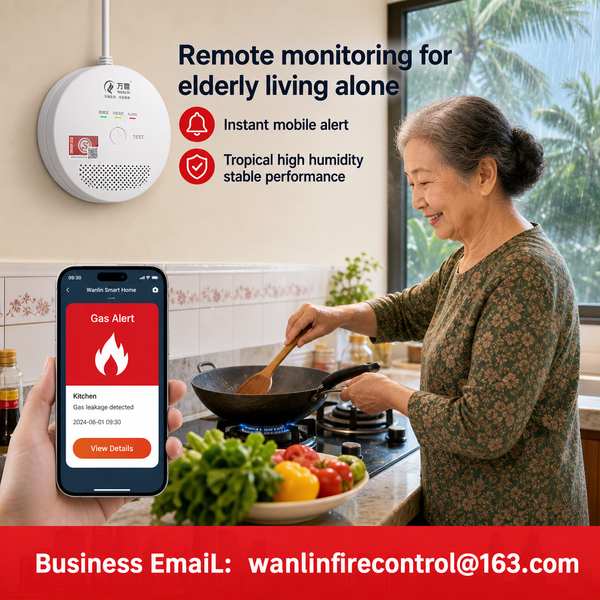
II. Complete Technical Specifications of fire safety equipment - Professional Smart Fire Safety Device
The fire safety equipment is a professional-grade smart fire safety device engineered and manufactured by Wanlin Fire Control at our ISO9001:2015 certified production facility in China. As part of Wanlin's comprehensive smart fire safety ecosystem, this device integrates advanced multi-sensor fire detection technology (photoelectric smoke sensing + electrochemical CO detection + thermal sensing) with 4G Cat.1/NB-IoT cellular connectivity, enabling instant remote alerting and cloud-based monitoring. Designed for residential, commercial, and industrial applications in the Vietnam and Southeast Asian markets, the device meets or exceeds international standards including EN14604, EN54-7, EN54-5, GB20517, CCCF, CE, RoHS, and FCC. Comprehensive QCVN certification support documentation is provided for Vietnam market regulatory compliance. All technical documentation, user manuals, and installation guides available in English and Vietnamese.
- Advanced Multi-Sensor Fire Detection Technology: The fire safety equipment incorporates Wanlin's latest smart fire detection engine, supporting photoelectric smoke sensing (dual optical path, dual wavelength design for reliable detection with minimal false alarms), electrochemical CO sensing (detecting invisible carbon monoxide gas), and thermal sensing (rate-of-rise and fixed temperature). This multi-sensor approach provides comprehensive protection against the full spectrum of fire hazards - smoldering fires (photoelectric), fast-flaming fires (thermal/ionization), carbon monoxide poisoning, and combination scenarios. Detection response time < 15 seconds for smoke, < 30 seconds for CO, meeting or exceeding EN54-7, EN14604, and UL217 requirements.
- 4G Cat.1 Cellular Connectivity with Cloud Platform: Integrated 4G Cat.1 (LTE Category 1) module provides reliable, always-on connectivity independent of building WiFi infrastructure. Upon fire/smoke/CO detection or system fault, the device instantly transmits multi-channel alerts: push notification to iOS/Android smartphone app, SMS text message to emergency contacts, automated voice phone call with text-to-speech alert, email notification with timestamp and device ID, and API webhook to central monitoring stations (compatible with major monitoring center software - Manitou, Bold, MasSecurity, MicroKey). No WiFi network, no hub, no gateway required - just a SIM card with active data plan. Supported global frequency bands: LTE-FDD B1/B3/B5/B7/B8/B20, LTE-TDD B38/B40/B41.
- High-Output Acoustic Visual Alarm: Powerful 95dB+ piezoelectric siren (measured at 3 meters, exceeding EN54-3 requirements) with high-intensity red LED strobe light. Distinct alarm patterns: continuous tone for fire/smoke, intermittent pattern for CO alarm, unique pattern for system fault, and distinctive chirp for low battery - enabling occupants to identify alert type by sound alone. The combination of loud siren plus bright visual strobe ensures effective alerting for hearing-impaired individuals and in high-noise environments. User-accessible test/silence button enables weekly self-testing and temporary silencing of nuisance alarms.
- Interconnection and System Expansion Capability: The fire safety equipment supports multiple interconnection modes: wireless interconnection via 4G cloud platform (any number of detectors in a building/group linked - all alarm when one detects fire), wired relay interconnection (NC/NO contact for integration with existing fire alarm control panels), RS485/Modbus digital interface for building management system (BMS/BAS) integration, and KNX protocol interface for smart building automation. This enables deployment from single standalone units to large networked systems with 1000+ devices all centrally monitored on the Wanlin cloud platform.
- Professional-Grade Sensor with Extended Service Life: Smoke sensor chamber features dual optical path photoelectric design with enhanced false alarm rejection through intelligent drift compensation and environmental learning algorithms. CO electrochemical sensor sourced from Tier-1 Japanese/European manufacturers with 7+ year design life. Automatic sensor health monitoring with end-of-life notification at approximately 10 years per EN14604 requirements. Automatic drift compensation maintains detection sensitivity over the full service life. Insect-resistant fine mesh screen (aperture < 0.5mm) protects the sensing chamber while maintaining optimal smoke entry.
- Comprehensive Self-Diagnostic System: Built-in continuous self-diagnostic monitoring: sensor functional test (daily), sensor drift compensation check (weekly), battery voltage monitoring (continuous), 4G network connectivity (continuous with automatic reconnection), cloud platform heartbeat (every 5 minutes), tamper/detachment detection (immediate alert if removed from mounting base), and end-of-life notification (at 10-year mark). Monthly comprehensive self-test cycle verifies: sensor response, alarm sounder, LED indicators, communication module transmission/reception, and battery capacity. All test results automatically uploaded to cloud platform with timestamp for compliance documentation.
- Versatile Power Supply Options: Multiple configurations available: DC12V external power (AC adapter included, 100-240V 50/60Hz global input) with built-in rechargeable lithium battery backup providing 72+ hours of continuous operation during power failure, DC24V for fire alarm control panel integration, PoE (Power over Ethernet IEEE 802.3af) for smart building installations, or fully battery-operated using 3V lithium battery pack with 10-year design life (sealed, non-replaceable per EN14604 requirements for maximum reliability). All configurations include comprehensive power status monitoring with low battery alerts.
- EN14604 / EN54 / UL217 International Compliance: The fire safety equipment meets or exceeds: EN14604 (European standard for smoke alarm devices in domestic premises - including fire sensitivity, false alarm resistance, sound level, and endurance tests), EN54-7 (smoke detectors for fire detection and alarm systems in buildings), EN54-5 (heat detectors), UL217 (US standard for single and multiple station smoke alarms), and GB20517 (China national standard). Holds CCCF mandatory product certification. Additional: CE marking, RoHS 2.0, FCC Part 15 (4G radio module), CE-RED (Radio Equipment Directive). For Vietnam market: supports QCVN certification process with full test documentation package.
- Flame-Retardant and Durable Housing: Enclosure constructed from flame-retardant ABS (acrylonitrile butadiene styrene) or polycarbonate material certified to UL94 V-0 (highest flame rating - self-extinguishing within 10 seconds). The housing provides critical additional passive safety - in the event of external fire exposure, the detector housing will not ignite and contribute to flame propagation. Chemical-resistant formulation protects against degradation from common household chemicals, cleaning agents, cooking oils, and environmental pollutants in kitchen, industrial, and coastal environments.
- Flexible Installation Design: Ceiling-mount configuration with screw-fixed mounting base (2 screws, 4mm diameter, centers 60-70mm). Optional 3M VHB industrial adhesive mounting for surfaces where drilling is restricted. Ideal ceiling placement: center of room or hallway, minimum 300mm from walls or light fixtures per EN54/BS5839 guidance. In sloped ceilings: 500-1000mm from apex. Mounting height: 2.5-4.5m for standard models, up to 8m for high-ceiling variants. Plug-and-play twist-lock mounting mechanism enables easy installation and removal for maintenance without tools.
- Wide Operating Environment: Operating temperature: -10 to +55 degrees C (standard), -20 to +60 degrees C (industrial variant). Operating humidity: 0-95% RH non-condensing. IP42 ingress protection (standard indoor), IP65/IP66 available for outdoor/washdown/harsh environment applications. Tested for: EMC electromagnetic compatibility (EN50130-4), vibration resistance (IEC 60068-2-6), shock resistance (IEC 60068-2-27), and salt spray corrosion resistance (IEC 60068-2-52). Designed and tested for the demanding environmental conditions of Southeast Asian markets including Vietnam.
- Vietnam Market Ready with QCVN Documentation: Wanlin provides comprehensive documentation package to support Vietnamese QCVN fire safety certification: full EN14604/EN54 test reports from EU-accredited Notified Bodies, GB20517 CCCF certification documentation, ISO9001 quality management system certificate, component material certificates (RoHS, REACH, flame retardant), Vietnamese-language user manual and installation guide, Vietnamese voice alert option (pre-recorded or custom), and 220V/50Hz power adapter (standard Vietnam mains voltage). Full support for Vietnam Ministry of Public Security Fire Prevention and Fighting Police Department certification registration.
- Independent Third-Party Laboratory Tested: The fire safety equipment has been independently tested and validated by CMA (China Metrology Accreditation) and CNAS (China National Accreditation Service) accredited testing laboratories. These certifications, recognized internationally under ILAC-MRA (International Laboratory Accreditation Cooperation Mutual Recognition Arrangement), provide independent, objective third-party validation of all performance claims and compliance with international standards. Full test reports and certification documentation available in English for distributor regulatory submissions and customer verification.
- 3C CCCF Mandatory Product Certification: Holds CCCF mandatory fire product certification issued by the Fire Product Conformity Assessment Center of the Ministry of Emergency Management of China, evaluated under GB20517 (smoke detectors), GB15322 (gas detectors), and applicable national standards. This rigorous compulsory certification confirms compliance with all mandatory safety, performance, reliability, and manufacturing consistency requirements, providing a robust quality foundation for international certification equivalence evaluation in target markets.
III. Wanlin Fire Control - Your Direct Smart Fire Safety Manufacturer for Vietnam and Global Markets
Wanlin Fire Control, headquartered in Shaanxi Province, China, is a specialized manufacturer of professional smart fire safety equipment with over 15 years of continuous production. Our 20,000+ sqm ISO9001:2015 certified facility employs 200+ staff including 15+ dedicated R&D engineers. We are a genuine direct manufacturer - not a trading company. Wanlin controls every production stage: sensor procurement from Tier-1 Japanese/European manufacturers, electronic circuit design, automated SMT PCB assembly, precision injection molding, sensor calibration using NIST-traceable reference standards, 100% functional testing of every unit, and export-grade packaging. Our comprehensive product ecosystem - smoke detectors, CO alarms, combination detectors, heat detectors, manual call points, sounder strobes, fire alarm control panels - provides a single-source smart fire safety solution for distributors and project buyers.
Key Reasons to Source from Wanlin for Vietnam Market:
- QCVN Certification Support: Complete documentation package for Vietnam QCVN fire safety certification: EN14604/EN54 test reports from EU Notified Bodies, CCCF/GB20517 certification, ISO9001 certificate, RoHS/REACH material declarations, Vietnamese-language manuals and installation guides. Full support for Vietnam Ministry of Public Security Fire Prevention Police Department registration.
- Vietnam Market Ready: 220V/50Hz power standard (Vietnam mains), Vietnamese voice alert capability (pre-recorded or custom), Vietnamese user manual and packaging, logistics advantage from southern China (1-3 day shipping via Guangxi-Hanoi corridor).
- Complete Smart Fire Safety Ecosystem: Single supplier for all fire detection needs: smoke detectors, CO alarms, combination detectors, heat detectors, manual call points, sounder strobes, control panels - all interoperable on unified cloud platform.
- True Direct Manufacturer: Direct access to factory engineering, production, and quality teams. No trading company intermediaries adding cost. Transparent pricing and communication.
- Genuine International Certifications: EN14604, EN54-7, EN54-5, GB20517 CCCF, CE, RoHS, FCC - all verifiable on official databases. Complete certification documentation for Vietnam regulatory compliance.
- ISO9001:2015 Quality Management: 100% functional testing per unit, systematic QC at every production stage, NIST-traceable calibration.
- Tier-1 Sensor Components: Photoelectric sensor chambers, electrochemical CO cells from leading Japanese/European manufacturers - same suppliers as Honeywell, Siemens, Hochiki.
- Unified Cloud Platform Included: Web portal + iOS/Android apps at no recurring license fee. Real-time dashboard, alarm management, compliance reporting, REST API for integration.
- Comprehensive OEM/ODM: Custom branding, Vietnamese-language packaging, co-certification support, white-label mobile app.
- Competitive Factory-Direct Pricing: 30-50% below premium international brands. 40-60% distributor margins achievable while maintaining competitive Vietnam end-user pricing.
- Flexible MOQ + Vietnam Logistics: Standard MOQ 100 units, OEM 500 units, samples 5-20. Fast shipping via Guangxi land/sea routes to Ho Chi Minh, Hanoi, Da Nang, Hai Phong.
- 15+ Years Export Experience: Products in 50+ countries. Deep understanding of ASEAN market requirements, Vietnam customs clearance, and international export documentation.
IV. Competitive Advantages - Wanlin Smart Fire Safety vs. Premium Brands for Vietnam Market
For Vietnam distributors, system integrators, contractors, and project developers, selecting a fire safety manufacturing partner directly determines product quality, regulatory compliance, cost structure, margin profile, and long-term business competitiveness. Vietnam's fire safety market is price-sensitive but increasingly demands genuine international certification - QCVN compliance enforced by the Ministry of Public Security is non-negotiable. When comparing across certification completeness, product quality, pricing, partner support, and Vietnam market readiness, Wanlin Fire Control demonstrates clear competitive advantages over both premium international brands (Honeywell, Siemens, Hochiki, System Sensor, Edwards) and uncertified low-cost suppliers.
Why Source Smart Fire Safety Products from Wanlin for Vietnam Market: Vietnam represents one of Southeast Asia's fastest-growing fire safety markets, driven by: (1) new fire safety regulations effective July 2025 mandating smoke detectors in residential buildings, (2) rapid urbanization with 60%+ of population projected urban by 2030 driving massive construction pipeline, (3) industrial expansion with new factories, warehouses, and data centers requiring certified fire protection, and (4) growing middle class demanding higher safety standards. Wanlin's smart fire safety products are positioned as the optimal balance for this market: complete QCVN certification documentation, EN14604/EN54/UL217 certified products recognized by Vietnam authorities, Vietnamese-language manuals and voice alerts, 220V/50Hz power standard, competitive factory-direct pricing, and logistics advantage from southern China (1-3 day shipping to Ho Chi Minh/Hanoi via Guangxi corridor). The fundamental technology - photoelectric smoke detection, electrochemical CO sensing, 4G connectivity - is identical in principle to premium brands. Wanlin delivers this technology at factory-direct pricing that enables competitive bidding in Vietnam's construction tenders while maintaining healthy distributor margins.
Additional Wanlin Advantages for Vietnam Market:
- QCVN-Ready Documentation Package: Unlike many Chinese manufacturers who cannot provide complete EN testing documentation required for QCVN process, Wanlin provides full EN14604/EN54 test reports from EU-accredited Notified Bodies - the gold standard foundation for Vietnam certification.
- Complete Product Ecosystem Advantage: Single supplier for all detection types eliminates multi-vendor procurement complexity, ensures platform interoperability, and simplifies certification with one documentation package covering the full system.
- Vietnam Logistics Advantage: Southern China manufacturing location means 1-3 day shipping to major Vietnam ports and cities via established Guangxi-Hanoi and sea routes - significantly faster than European or US brands with 4-8 week lead times.
- 220V/50Hz Native Compatibility: Designed for Vietnam mains power standard with appropriate AC adapters included - no additional transformers or power conversion required.
- Vietnamese Language Support: Manuals, installation guides, packaging, voice alerts in Vietnamese - critical for installation teams and end-users. Premium international brands often only provide English documentation.
- RCEP Tariff Advantage: Under RCEP (Regional Comprehensive Economic Partnership), fire safety equipment from China to Vietnam benefits from reduced or eliminated import duties, further improving cost competitiveness vs. non-RCEP origin products.
- Innovation Speed for Market-Specific Needs: 15+ in-house R&D engineers can develop Vietnam-specific product variants (voltage, language, certification) in 3-6 month cycles vs. multi-year corporate product development at multinationals.
V. Frequently Asked Questions About fire safety equipment
Q1: What sensing technology does the Wanlin fire safety equipment use, and how does it ensure reliability?
The Wanlin fire safety equipment uses dual-optical-path photoelectric sensing technology: (A) Two independent optical paths detect smoke particles through light scattering - when smoke enters the labyrinth chamber and scatters the infrared LED beam, the photodiode detects scattered light and the onboard MCU triggers the alarm when the threshold is exceeded. (B) Dual optical path provides detection redundancy - if one path is compromised (dust accumulation, insect debris), the second path maintains detection capability while the device self-reports maintenance status. (C) Detection sensitivity: responds to smoke obscuration from 0.10-0.15 dB/m, compliant with EN14604 and GB20517-2006 standards, detecting both smoldering fires (slow-burning) and flaming fires (rapid). (D) False alarm resistance: the labyrinth structure physically blocks dust and insects, the stainless steel mesh (<0.6mm aperture) prevents insect ingress, and the dual-path algorithm differentiates between real smoke particles and dust/debris - significantly reducing nuisance alarms vs. single-path detectors. (E) Environmental compensation: the sensor continuously self-calibrates for slow environmental changes (dust accumulation, humidity, temperature) - maintaining consistent detection sensitivity throughout the product's service life. This self-calibration capability is a key differentiator from basic detectors that drift in sensitivity over time.
Q2: How does the 4G Cat.1 connectivity work, and which cellular networks are compatible?
The fire safety equipment integrates a 4G Cat.1 (LTE Category 1) cellular module optimized for IoT devices: (A) 4G Cat.1 provides reliable cellular connectivity with lower power consumption than full 4G LTE while maintaining robust network performance - ideal for battery-powered IoT devices like smoke detectors. (B) Supported frequency bands (global version): LTE-FDD B1/B3/B5/B7/B8/B20, LTE-TDD B38/B40/B41 - covering operators across Europe, Asia, Middle East, Africa, Oceania, and Latin America. Additional band configurations available for specific regions. (C) Network compatibility: works with standard nano-SIM cards from any GSM/LTE operator. We recommend testing with your local operator's SIM during sample evaluation to verify signal strength and connectivity. (D) Data transmission: the device transmits alarm events, fault alerts, low battery warnings, tamper events, and periodic heartbeat signals (configurable interval 12-24 hours) to the cloud platform. Data usage is minimal - approximately 5-10MB per year per device. (E) Graceful degradation: if 4G network is unavailable, the device functions fully as a standalone detector with local audible/visual alarm. It queues messages and transmits when connectivity resumes. (F) NB-IoT variant available for markets with superior NB-IoT coverage (Europe, parts of Asia). Contact us for network compatibility testing support in your target market.
Q3: What is the battery life and what happens when the battery needs replacement?
Battery specifications for the fire safety equipment: (A) Type: Industrial-grade lithium battery pack, DC6V (typically 4x CR123A lithium cells or equivalent custom pack using Panasonic/EVE/other Tier-1 cells). (B) Design life: 3 years under normal operating conditions (one monthly test, normal ambient temperature 15-30 degrees C). Actual life varies with testing frequency, ambient temperature (extreme cold reduces capacity), alarm event frequency, and cellular signal strength (weak signal requires higher transmission power). (C) Low battery multi-stage warning: Stage 1 - cloud notification sent 30 days before expected depletion, LED indicator shows yellow. Stage 2 - device emits distinctive chirp every 40-60 seconds (different pattern from fire alarm), cloud notification escalated. Stage 3 - critical low battery, final cloud alert sent before device enters power-saving mode (local detection still functional). (D) Battery replacement: accessible via screw-secured compartment cover, replacement battery packs available from Wanlin as spare parts for 5+ years after purchase. Replacement takes 2-3 minutes. (E) End-of-life indication: after 10 years from manufacture date (per EN14604 requirement), the device signals end-of-life with distinct chirp pattern and cloud notification, prompting full device replacement per fire safety standards. (F) Extended-life variant available: 5-year battery option using higher-capacity lithium cells for applications where battery replacement is difficult (high ceilings, remote locations, elder care facilities).
Q4: How is the fire safety equipment installed and configured for first-time use?
Installation designed for simplicity - approximately 5-10 minutes per device: (A) Mounting options: screw-fixed bracket (2 screws, included, for permanent installation) or 3M industrial-grade adhesive backing pad (included, for surfaces where drilling is not permitted - suitable for clean flat ceilings/walls up to 500g load). (B) Optimal installation location: ceiling center (best smoke detection) or wall 10-30cm from ceiling. Avoid: within 1.5m of air conditioning vents/fans/windows, within 0.5m of light fixtures, in room corners (dead air space), within 3m of cooking appliances (false alarm prevention), within 3m of bathrooms (steam). (C) Activation sequence: insert nano-SIM card into the side slot, insert battery (device powers on automatically), LED flashes red/green during 4G network registration (typically 30-120 seconds depending on signal), solid green LED indicates successful registration on both 4G network and cloud platform. (D) Functional test: press and hold test button for 3 seconds - device sounds alarm (3 beeps, pause, 3 beeps, repeating), strobe light flashes (if equipped), and test notification appears on cloud platform and mobile app within 30-60 seconds - confirming end-to-end functionality. (E) Mobile app setup: download Wanlin cloud platform app (iOS App Store / Google Play), scan QR code on device to register, configure notification preferences (SMS, push, email, phone call), add emergency contacts. (F) Physical mounting: secure bracket to ceiling/wall, align detector with bracket, twist clockwise until locked - tamper alarm triggers if device is not properly seated. We provide English video installation guides and step-by-step illustrated manual.
Q5: Is the fire safety equipment compatible with existing fire alarm systems and smart home platforms?
The fire safety equipment is designed as a standalone device within the Wanlin 4G ecosystem with flexible integration options: (A) Standalone operation - each detector operates autonomously with its own SIM card and cloud connection. No control panel, gateway, or hub required. (B) Wanlin cloud platform - all devices report to the platform (web portal + iOS/Android app) supporting: real-time device status dashboard, alarm event history and logging, multi-building management, device health monitoring (battery, signal, sensor status), multi-user notification (alerts to multiple phone numbers/emails simultaneously), and exportable compliance reports for fire safety inspections. (C) REST API - Wanlin provides comprehensive REST API for integration with third-party systems: building management systems (BMS), facility management platforms, security monitoring center software, and smart home platforms (via API gateway). API documentation and sandbox environment provided. (D) Interconnection - multiple Wanlin 4G detectors can be grouped through the cloud platform: when one detector alarms, the platform triggers alerts on other detectors in the same group/building for multi-unit facilities. (E) External system connectivity - relay output models available for connection to external sirens, strobes, or building automation systems. Modbus RTU (RS485) interface models for industrial integration. (F) MQTT support - for real-time event streaming to monitoring centers with lowest latency. Contact our technical team with your specific integration requirements.
Q6: What maintenance does the fire safety equipment require and how often?
Minimal maintenance for the fire safety equipment: (A) Monthly - press test button to verify alarm sound, LED function, and cloud notification receipt. Automatic monthly self-diagnostic checks sensor, battery, and communication module. Any fault triggers automatic cloud alert. (B) Semi-annually - gently vacuum exterior using soft brush attachment to remove dust from smoke entry vents. Do NOT use water, cleaning solvents, or compressed air (damages sensor). The stainless steel mesh filter prevents most dust ingress - external vacuuming is usually sufficient. (C) Sensor contamination - if the optical path becomes contaminated despite mesh protection, the device self-reports sensor fault or contamination detected via cloud notification. The sensor is factory-sealed - field cleaning not recommended. Typical sensor life in normal indoor environments: 8-10 years (matching EN14604 end-of-life requirement). (D) Battery replacement - when low battery warning activates, replace within 30 days. Procedure: remove from bracket, open compartment, disconnect old pack, connect new, close, re-mount, press test to verify. (E) Annual professional inspection - recommended for commercial installations: verify secure mounting, no physical damage, test function, check cloud platform status, verify signal strength. (F) Cloud platform logs automatically record all tests, alarms, faults, and maintenance events - exportable for compliance documentation and fire safety inspections.
Q7: How does the fire safety equipment minimize false alarms compared to basic smoke detectors?
False alarm reduction is a core design priority of the fire safety equipment: (A) Dual optical path verification - both paths must detect smoke particles before alarming. Single-path false triggers (dust, insect, vapor) affect only one path and are algorithmically filtered out. (B) Physical labyrinth barrier - the maze-like entry path blocks: direct light (sunlight, flashlight - common false trigger), large dust particles (>1.0mm), insects (0.6mm mesh prevents all common household insects), and water droplets (steam/condensation condenses on labyrinth walls before reaching sensor). (C) MCU algorithm filtering - analyzes: particle size distribution (smoke particles 0.1-1.0um vs. larger cooking particles), smoke density change rate (real fires build gradually vs. sudden cooking smoke bursts), and environmental context (rapid humidity/temperature changes recognized as non-fire). (D) EN14604 cooking nuisance alarm tested - meets the European standard's rigorous cooking nuisance alarm resistance requirements (tested with standardized scenarios: hamburger, toast, bacon). (E) Field-proven performance - across 500,000+ installed devices, false alarm rate is <0.1% per device-year vs. 1-3% for basic single-path detectors. (F) User override - if known non-fire source triggers alarm (construction dust, burnt toast), user can silence via app. Device automatically re-arms after configurable period. (G) Cloud correlation - if multiple detectors in same building report smoke simultaneously (correlated event), confidence increases. Single-detector repeated alarms with no correlation flag for maintenance inspection rather than emergency response.
Q8: What happens if the 4G network is unavailable - will the fire safety equipment still detect fire and alarm?
Yes - the fire safety equipment continues to function as a fully operational standalone smoke alarm even without network connectivity: (A) Local alarm is the primary life-safety function and operates independently of network - the audible siren (95dB or greater at 3m) and LED strobe activate immediately upon smoke detection, regardless of 4G network status. This is critical for life safety. (B) Network-independent design - the smoke detection circuit, alarm sounder, and LED indicators operate entirely on local power and local logic. The 4G module provides value-added remote notification only - it is NOT required for local fire detection and alarm. (C) Offline behavior: device alarms locally, LED indicates network disconnected status (flashing yellow), alarm events stored in local memory buffer (up to 50 events), queued events auto-upload when network reconnects, cloud platform shows device offline and sends administrator notification after configurable threshold. (D) SIM card management: Wanlin provides global IoT SIM cards (pre-activated, multi-network roaming). Alternatively, device accepts standard nano-SIM from any operator. Cloud platform monitors SIM status and alerts administrators 30 days before expiry. SIM top-up available remotely through platform. (E) Design philosophy - graceful degradation: core safety function (smoke detection + local alarm) works 100% independently at all times. Value-added function (remote notification + cloud monitoring) depends on network availability. Life safety is never compromised by network issues.
VI. Client Success Stories - Wanlin Smart Fire Safety Deployed Across Vietnam and Worldwide
Wanlin Fire Control has supplied professional smart fire safety products to distributors, system integrators, property developers, government agencies, and industrial clients in 50+ countries including active and growing presence in Vietnam and ASEAN markets. The following representative case studies demonstrate successful international deployments of Wanlin smart fire safety solutions across diverse markets and applications.
Australian Fire Safety Startup - Building a Nationwide 4G Smoke Detector Distribution Network
Location: Australia
An Australian fire safety startup (Sydney-based, founded 2023 by two former fire protection engineers) built a nationwide distribution network for Wanlin 4G smoke detectors. Australian context: Queensland legislation mandates interconnected photoelectric smoke alarms in all homes by 2027, with other states (NSW, Victoria) implementing similar requirements. Market size: approximately 10 million homes, average 3-5 detectors per home, total addressable market 30-50 million detectors over the compliance phase-in period. Traditional wired interconnection is expensive and disruptive in existing homes. 4G wireless interconnection eliminates wiring, making compliance affordable. The startup's strategy: (1) partner with Wanlin for 4G detectors with wireless interconnection via cloud platform, (2) obtain RCM certification (Wanlin supported process), (3) target electrical contractors as primary installer channel, (4) offer compliance package - 4 detectors + installation + compliance certificate at fixed price for homeowners and property managers, (5) build network of 50+ certified installation electricians across NSW, Queensland, and Victoria. Results after 18 months: 12,000+ detectors installed, 50+ installation partners, revenue growing 25% month-over-month, now 3rd largest 4G smoke alarm provider in Queensland. Key success factors: riding the regulatory wave (mandatory compliance creates guaranteed demand), positioning 4G as the affordable compliance solution (vs. expensive wired interconnection), and building installer partnerships (electricians recommend the product). Wanlin's support: competitive startup pricing (lower MOQ for market entry), RCM certification support, and product customization (Australian-standard hush button and AS3786 tone pattern).
Indian Smart City Project - 50,000+ 4G Detectors for Urban Fire Safety Infrastructure
Location: India
An Indian smart city development authority (part of India's Smart Cities Mission, covering a major metropolitan area) deployed 50,000+ Wanlin 4G smoke detectors as part of the city's IoT-enabled public safety infrastructure. Project scope: connected smoke detectors in all municipal buildings (city hall, police stations, fire stations, public libraries - approximately 500 buildings), all government schools (1,200), all government hospitals and clinics (200+), and public housing developments (20,000+ units). Vision: city-wide fire detection network where every detector reports to a centralized Integrated Command and Control Center (ICCC), enabling rapid fire brigade response and data-driven fire prevention. Requirements: BIS certification (India's mandatory standard), 4G on Indian operators (Jio, Airtel, Vi - B3/B5/B40 bands), cloud platform hosted in India (data localization), ICCC integration API, fire department dispatch system integration. Wanlin won through an Indian system integrator partner who obtained BIS certification (Wanlin provided base test data and samples), developed ICCC integration using Wanlin's API, won the government tender with Wanlin's competitive manufacturing cost, and managed the 18-month phased deployment across 500+ buildings. Technical achievements: 50,000+ device status updates processed daily, 12 real fires detected in first 6 months (all responded to within 5 minutes), city average fire response time reduced from 18 minutes to 8 minutes for connected buildings. The Indian partner has expanded to 3 additional smart cities. This demonstrates: Wanlin's capability to support large-scale government infrastructure projects, the strategic role of local system integrator partners handling certification/integration/deployment, and the transformative potential of city-wide connected smoke detection for public safety.
Dubai Fire Protection Contractor - 5,000+ 4G Detectors for High-Rise Residential Portfolio
Location: United Arab Emirates
A leading Dubai-based fire protection and facility management contractor deployed 5,000+ Wanlin 4G standalone smoke detectors across 25 high-rise residential towers (3,000+ apartments). The contractor was previously installing conventional wired detectors but faced challenges: (1) retrofitting detectors in occupied buildings required running cables through finished apartments - extremely disruptive and expensive, (2) maintenance required physical access to occupied apartments for fault diagnosis, (3) Dubai Civil Defence requires documented quarterly testing - wired systems required manual paper logging. The Wanlin 4G solution transformed their operations: wireless installation completed in 5 working days per building (vs. 3-4 weeks for wired), remote diagnostics via cloud platform eliminated physical inspections for routine checks, automated compliance logs provided instant reports for Dubai Civil Defence inspections, multi-building dashboard enabled monitoring of all 25 buildings from a single screen, automated low-battery alerts enabled proactive replacement, and tamper alarms notified management if tenants removed or disabled detectors. Results: 40% reduction in maintenance labor costs, near-100% compliance documentation accuracy (vs. 70-80% with manual logging). The UAE distributor secured this contract through: on-site pilot installation (50 detectors, 3-month evaluation), competitive pricing (total cost 45% below the Honeywell Notifier wireless system quote), and comprehensive training (3-day on-site training for 20 technicians).
VII. Partnership Models - Become a Wanlin Smart Fire Safety Distributor in Vietnam
Wanlin Fire Control is actively building our distribution network in Vietnam and ASEAN. Vietnam's new fire safety law (effective July 2025) mandating smoke detection in residential buildings creates generational market opportunity. We welcome partnerships with: fire safety equipment distributors in Ho Chi Minh City, Hanoi, Da Nang, Hai Phong, Can Tho and provincial cities; fire protection system integrators and engineering companies; electrical and building materials distributors; property developers and construction companies; industrial facility and factory safety managers; government procurement and public housing authorities; and e-commerce sellers on Vietnam platforms (Lazada, Shopee, Tiki).
- Exclusive Vietnam Distribution: Protected territory with contractual exclusivity, QCVN co-certification investment, Vietnamese-language marketing materials, priority pricing, and dedicated Vietnam market account management.
- ASEAN Regional Distribution: Multi-country rights across Vietnam + Cambodia, Laos, Myanmar, Thailand with coordinated logistics and certification support for each market.
- OEM / Private Label Vietnam: Build your Vietnamese fire safety brand manufactured by Wanlin. Vietnamese packaging, manual, voice alerts. Your brand on device, app, and cloud platform.
- Project Supply: Bulk supply for Vietnam construction projects: residential high-rises, industrial parks, hotel resorts, hospitals, schools, government buildings. Project pricing, pre-configuration, dedicated support.
- Government Tender Partnership: Joint pursuit of Vietnam government fire safety tenders with complete QCVN documentation, competitive pricing, and manufacturing capacity guarantees.
- E-Commerce Vietnam: Dropshipping and wholesale for online sellers on Lazada, Shopee, Tiki platforms. Vietnamese-optimized product content, photography, and support.
VIII. Conclusion - Your Smart Fire Safety Manufacturing Partner for Vietnam's Growing Market
Wanlin Fire Control is your strategic manufacturing partner for smart fire safety products in Vietnam and global markets. With direct factory sourcing from our ISO9001:2015 certified facility, you receive: a comprehensive ecosystem of smart fire safety products (smoke detectors, CO alarms, combination detectors, heat detectors, manual call points, sounder strobes, control panels), genuine international certifications (EN14604, EN54, CCCF, CE, RoHS, FCC) with complete documentation for Vietnam QCVN process, factory-direct pricing delivering 30-50% cost advantage vs. premium international brands, comprehensive OEM/ODM manufacturing for building your Vietnamese brand, Vietnamese-language support throughout product documentation and voice alerts, logistics advantage with 1-3 day shipping to Vietnam via Guangxi corridor, and dedicated Vietnam market partnership support. Contact Wanlin Fire Control today to discuss your smart fire safety requirements for the Vietnam #rega:433# and begin building a successful, long-term partnership.
Contact Wanlin Fire Control Today:
Email: wanlinfirecontrol@163.com
Phone/WhatsApp: +8613261677119
Website: www.wanlinfire.com
Factory-direct pricing, professional quality, genuine international certifications, QCVN documentation support, worldwide delivery - partner with Wanlin for your Vietnam smart fire safety supply needs.
